
You Don't Have Anxiety, You've Outgrown Your Conditioning


In this blog, I want to riff on something that’s been coming up a lot lately in my own personal life and in the lives of my clients.
I'm talking about the journey from the conditioned self to the true self.
Every single one of us has a conditioned self.
The conditioned self is basically the person you’ve learned to be up until this point in your life.
All of your conditioning from childhood, your experiences, your environment, the way you learned to fit in, belong, and stay safe.
All of that created the version of you that you know today.
That’s your conditioned self.
The aim of the game is to live in alignment with your true self.
It's too move from conditioning to coherence.
And the reason that matters is simple...
When you’re living in alignment with your true self, anxiety and depression are no longer a major problem.
They don’t dominate your life the way they do when you’re disconnected from who you really are.
When you’re aligned with your true self:
- Life becomes enjoyable and fulfilling
- Confidence comes naturally
- You feel calm, coherent and at peace
You stop trying to be someone you think you "should" be.
That’s why I use language like alignment, authenticity, and true self.
Confidence isn’t something you manufacture, it’s something that emerges when you’re living in truth.
The conditioned self, on the other hand, is always playing the game of external validation.
- Trying to fit in.
- Trying to be accepted.
- Trying to stay safe by being familiar.
The true self doesn’t play that game.
My Own Journey Out of Conditioning
I’ve taken this journey myself.
I genuinely believe that I’m living far more in alignment with my true self now than I ever have before but that doesn’t mean I’ve “finished” growing.
Growth never ends. You keep maturing, like a tree that just keeps growing.
But I’ve shed a lot of conditioning.
There was a time in my life where I was doing a lot of things I didn’t actually want to do:
- Drinking
- Drugs
- Hanging around people who weren’t good for me
- Trying to fit into unhealthy environments
At the time, those things gave me a sense of belonging and safety but it was actually a false sense of safety.
That’s important to understand.
Conditioning works, until it doesn’t.
Regulation vs Avoidance
This came up in a conversation I had recently about regulation.
A lot of people regulate themselves in ways they don’t even realise.
Drinking, medication, compulsive behaviours... these things can create a temporary sense of relief.
There’s a moment where it feels like an exhale. Like, “Ahh, I’m okay now.”
And in that sense, yes, it does regulate you in the short term.
But it doesn’t move you toward your true self.
It keeps you stuck in a cycle.
Understanding why you do these things is actually one of the most powerful steps in raising consciousness.
For someone who feels trapped and doesn’t know why, simply understanding the mechanism can be enough to start creating change.
A Simple Example: Emptiness and Avoidance
In the video linked above, James shared an example of feeling empty after a really good day, then having a couple of drinks and feeling “complete” again.
On the surface? Totally fine. You’re allowed to enjoy your life.
But if we look a little deeper, we see something important.
The drink wasn’t about celebration, it was about avoiding the feeling of emptiness.
That emptiness was uncomfortable, so something was used to change the state.
And that’s the real point.
When we’re uncomfortable with what we’re feeling (emptiness, anxiety, restlessness) we often reach for something to change it:
- Alcohol
- Medication
- Distraction
- Work
- Stimulation
It’s the same mechanism every time.
Uncomfortable feeling → do something → feel better temporarily.
That’s regulation through avoidance.
The Real Skill: Sitting With What You Feel
If I’m coaching at the highest level, the question becomes:
- What’s wrong with feeling empty?
- What’s wrong with feeling anxious?
- What's wrong with the discomfort?
The real work isn’t about eliminating feelings, it’s about learning how to be present with them.
This is the same skill required to face anxiety.
Instead of trying to escape the feeling, you pause.
You notice the compulsion to reach for something.
You ask yourself:
- Is this coming from my conditioned self, or my emerging true self?
Then you sit with the feeling even just one or two minutes longer than you normally would.
- You don’t fight it.
- You don’t try to fix it.
- You just allow it to be there.
Very often, the feeling dissolves naturally on its own.
That’s how letting go actually works.
You don’t do anything to let go, you stop resisting what’s already there.
The Void: The Real Work of Transformation
This journey from the conditioned self to the true self always requires passing through what I call the void.
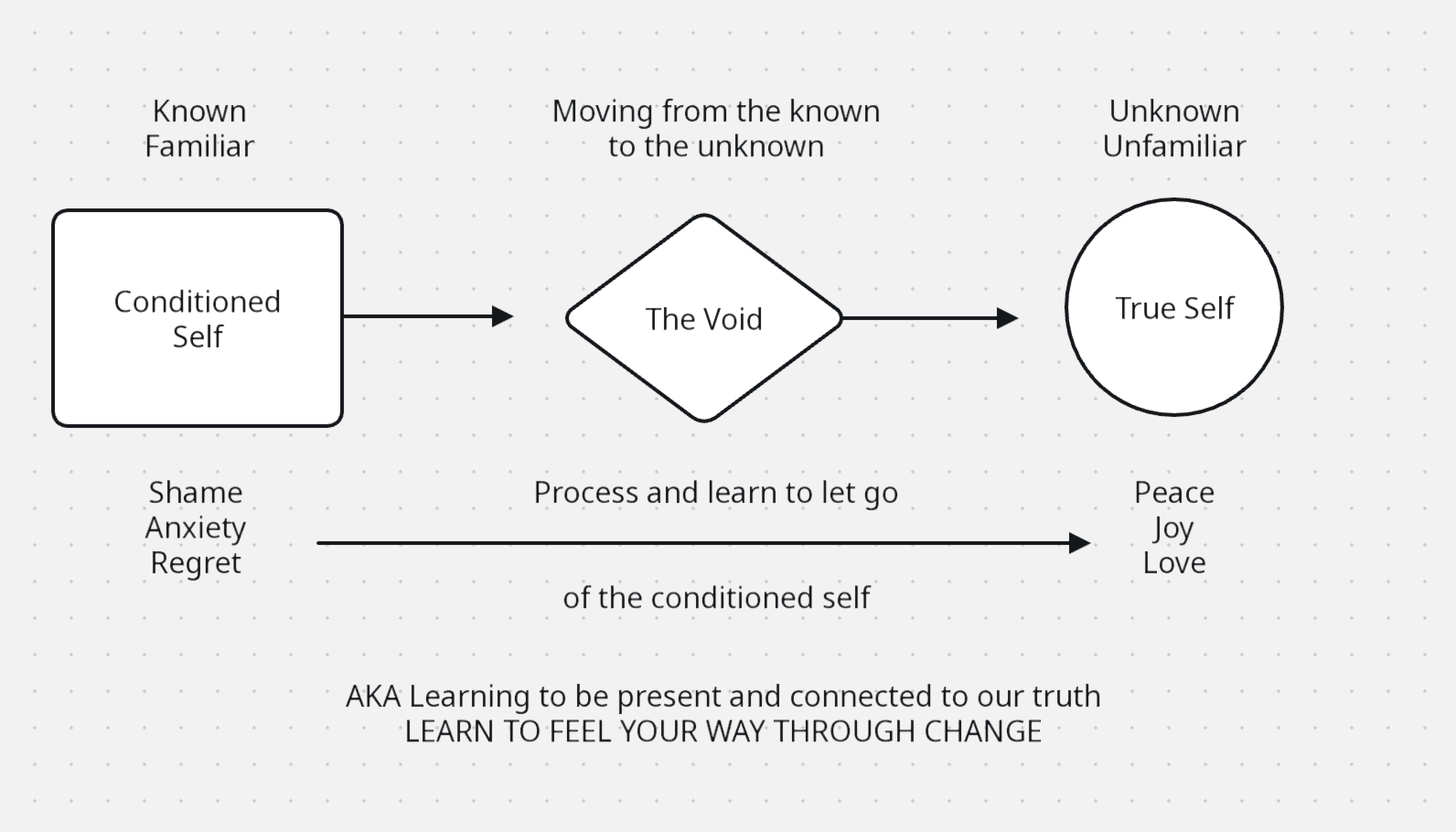
The conditioned self is the known and the familiar.
The true self is unknown and unfamiliar.
The void sits in between.
This is the danger zone, not because it’s bad, but because it’s uncertain.
In the void:
- Fear can come up
- Doubt can come up
- Shame, guilt, and regret can surface
This is where people often retreat back to the familiar (drinking, drugs, lying, gambling, distractions) anything that keeps them feeling safe in the old identity.
But the void is actually where the real work happens.
Processing.
Letting go.
Learning to feel.
You don’t bypass this stage.
You have to move through it.
From Head to Heart
Your excuses live in your head.
Presence lives in your body.
This journey isn’t about thinking your way through change, it’s about feeling your way through it.
Meditation.
Breathwork.
Journaling.
Self-reflection.
Walking.
These practices can bring you out of your head and back into your body, where truth actually lives.
If you want to move from the conditioned self to the true self, you have to stop avoiding what you feel and start learning how to be present with it (even when it’s uncomfortable).
A Simple Integration Tip
For the next week, notice when you feel the urge to reach for something:
Alcohol
Medication
Distraction
Compulsion
Pause.
Be present with what you’re feeling for a couple of minutes longer than usual.
Let yourself feel it without judgment.
Then observe what happens.
That’s where the shift begins.
With Optimism,
Josh